
One of the biggest challenges in Learning & Development is not designing great learning experiences. It’s proving that they made a difference.
For years, organisations have invested heavily in training and then attempted to evaluate its impact afterwards. We run the programme, collect a few satisfaction scores, count attendance numbers, and then wonder why stakeholders remain unconvinced about the value created.
The problem isn’t usually the training.
The problem is that evaluation starts too late.
If we genuinely care about impact and return on investment, we need to stop treating evaluation as the final stage of a project and start embedding it at the very beginning. Research and industry practice continue to highlight the limitations of relying solely on learner reactions and completion rates, with increasing pressure from leaders to demonstrate behavioural and business outcomes.
Before a single piece of content is designed, we should be asking:
- What problem are we trying to solve?
- How will we know if we’ve succeeded?
- What matters most to stakeholders?
- What evidence would convince them that this investment was worthwhile?
Too often, L&D collects every possible metric because it can. Yet the most effective evaluation strategies focus on what matters rather than what is merely measurable.
- Attendance isn’t impact.
- Completion isn’t impact
- Even engagement isn’t impact.
- Impact is what changed because learning happened.
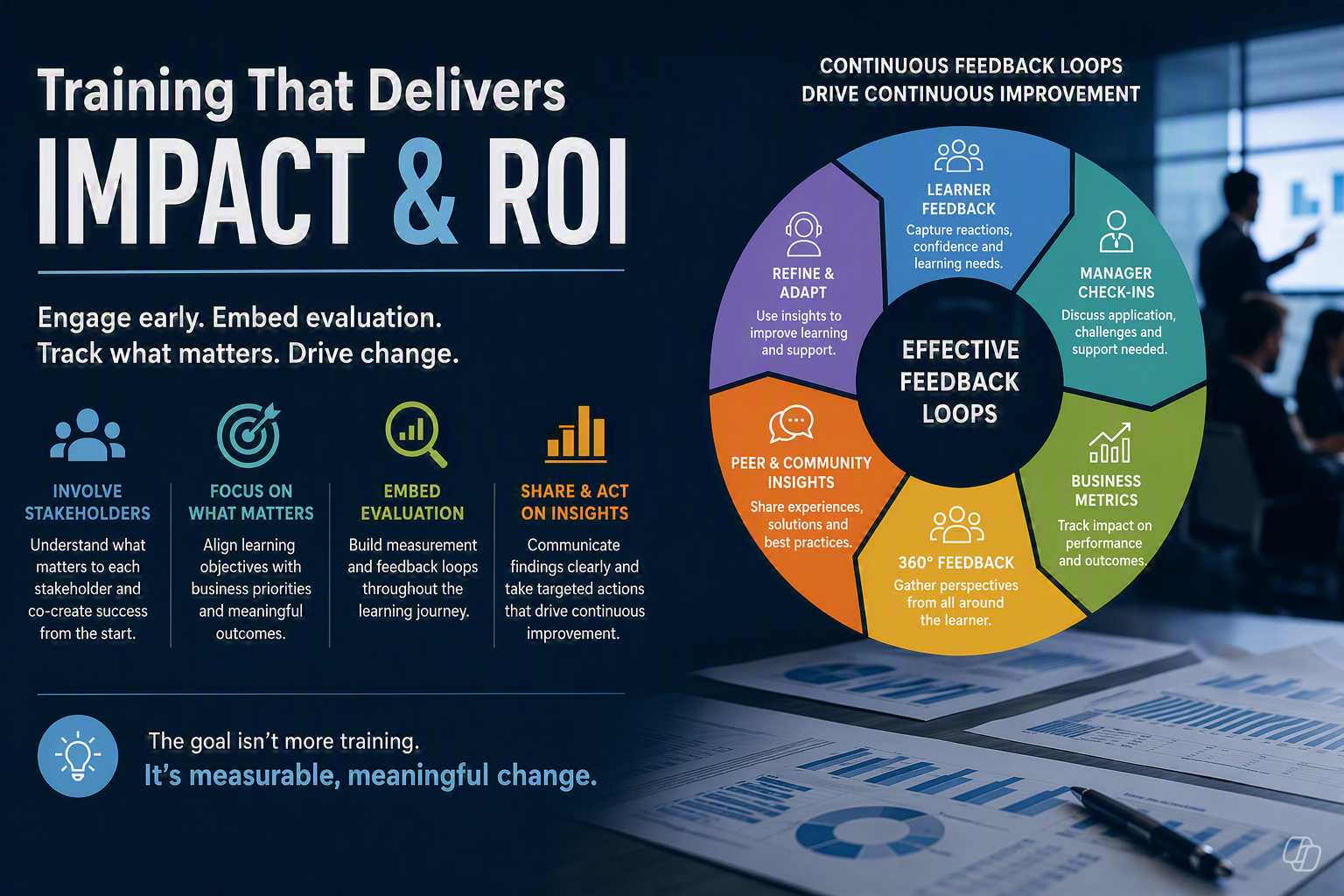
That shift requires involving stakeholders early. Managers, leaders, learners, customers, regulators, operational teams, and sponsors may all define success differently. A finance director may care about cost reduction. A customer service leader may want improved satisfaction scores. A line manager may be looking for improved confidence and capability within their team.
None of them are wrong.
Our role is to understand what success looks like through their lens and then build measurement around those outcomes.
This is where feedback loops become essential. Not one survey at the end, but multiple opportunities to gather insight throughout the process. Learner feedback. Manager observations. Business metrics. Peer reviews. Post-programme reflections. Continuous feedback loops create a richer picture of performance and help learning evolve over time rather than being judged at a single point.
360-degree feedback can be particularly powerful when used thoughtfully. It helps uncover behavioural changes that traditional training metrics often miss. However, it also has limitations. Bias, inconsistent participation, and poorly framed questions can distort results. Used well, it provides valuable context. Used badly, it becomes noise.
The same is true of data.
More data is not better data.
Collect too much and the signal gets lost in the noise. Measure too little and important insights are missed. The goal is focused, meaningful evidence that informs decisions and drives action.
Perhaps the most important question L&D professionals should ask is not:
“Did people enjoy the training?”
But rather:
“What changed, for whom, and why?”
Because when evaluation is embedded from the start, when stakeholders are involved throughout, when feedback loops are continuous, and when metrics are aligned to business priorities, we move beyond counting learning activity.
We start demonstrating real impact.
And that’s where ROI becomes a conversation about value, not cost.


